
Encarei o número até que ele se tornasse borrado.
Sessenta e sete mil e quatrocentos dólares.
Não foi um erro. Não foi um mês ruim. Não foi uma família sob pressão.
Era um padrão nos recibos.
Clayton colocou outra página ao lado. Meus pedidos. Minhas datas. Meus valores.
15 de novembro de 2024: Solicitei US$ 2.000 para tratamento da dor. Negado. Na mesma semana: US$ 2.100 para o curso de coaching empresarial da Vanessa.
20 de fevereiro de 2025: Solicitei US$ 1.440 para fisioterapia. Negado. Naquele mês: US$ 850 para as fotos de marca da Vanessa.
10 de junho de 2025: Solicitei US$ 600 para um colchão. Negado. Na mesma semana: US$ 600 para equipamentos fotográficos.
8 de novembro de 2025: Solicitei US$ 85 para medicamentos para dor. Negado. No mesmo dia: pagamento de US$ 600 no cartão Visa para a Vanessa.
No mesmo dia.
Essas duas palavras ficaram gravadas na minha mente.
No mesmo dia.
Quando pedi remédios, pagaram a dívida dela.
Quando pedi terapia, pagaram pela imagem dela.
Quando pedi para dormir, pagaram pela iluminação dela.
Quando pedi a cirurgia, eles esperaram até que eu não pudesse mais impedi-los.
Clayton fechou a pasta.
“Quero dizer uma coisa, e quero que você se lembre disso quando sua família tentar reescrever a história.”
Olhei para ele.
“Não foi Vanessa que precisava de ajuda mais do que você. Foi seus pais decidindo que o conforto dela importava mais do que a sua dor.”
Pressionei as palmas das mãos contra o cobertor.
“Eles me enrolaram por dois anos.”
“Não posso provar que a demora foi apenas para criar essa oportunidade.”
“Mas você acha que sim.”
Seu silêncio foi cauteloso.
“Sim”, disse ele. “Acho que eles sabiam que sua cirurgia criaria uma brecha. E acho que se prepararam para isso.”
A conta conjunta aberta quarenta e três dias antes da cirurgia.
O login salvo para emergências.
A mensagem enviada noventa e oito minutos após a anestesia.
Faça agora enquanto ela não pode verificar.
Alguns crimes gritam.
Este se agendou sozinho.
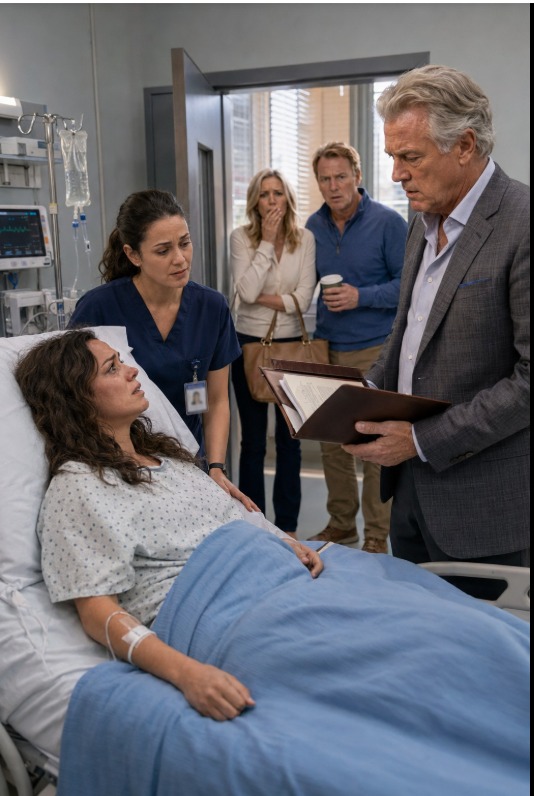
Jordan visitava todas as tardes. Na primeira vez que ela me viu depois da cirurgia, entrou no quarto carregando uma sacola cheia de lanches, anotações de aula, meias felpudas e uma fúria que tentava disfarçar.
Ela não conseguiu.
"Vou dizer uma coisa", anunciou, colocando a sacola no chão. "Depois, serei compreensiva e calma."
Me preparei para o pior.
"Seus pais são cupins humanos."
Jackie, que estava ajustando meu soro, fez um som de engasgo e fingiu tossir.
Eu ri, mas imediatamente me arrependi, porque rir depois de uma artrodese da coluna era como ser punida por alegria.
"Não me faça rir."
"Tudo bem. Serei entediante. Como está sua dor?"
"Suportável."
"Isso é um reflexo, não uma resposta."
"O professor Whitman disse a mesma coisa."
" “A professora Whitman está convidada para minha futura comunidade de adultos emocionalmente competentes.”
Jordan sentou-se ao meu lado e tirou uma pilha de anotações de aula impressas. Ela as havia organizado por cores, de acordo com a disciplina. Também havia escrito comentários sarcásticos nas margens, onde achava que eu precisaria de motivação.
Na minha apostila de direito constitucional, ao lado de uma discussão sobre devido processo legal, ela havia escrito: SUA FAMÍLIA FALHOU NO DEVIDO PROCESSO LEGAL, TANTO NO PROCESSO LEGAL QUANTO NO SUBSTANTIVO.
Eu chorei quando
Eu vi.
Não porque fosse engraçado.
Porque ela sabia exatamente como me fazer sentir eu mesma.
No segundo dia, Jordan trouxe sua mãe, Linda.
Linda me olhou e não perguntou se eu estava bem. Enfermeiras não te insultam assim.
Em vez disso, ela lavou as mãos, verificou se o botão de chamada estava ao alcance e disse: “Você vai para casa conosco depois da alta.”
Pisquei. “Não posso.”
“Você pode.”
“I have a dorm.”
“With stairs, a shared bathroom, and a roommate who has classes.”
“Jordan is my roommate.”
“And she has classes,” Linda said. “Our guest room is ready.”
I looked at Jordan.
She shrugged. “I told her you’d argue. She said good, that means your brain works.”
I wanted to protest. I wanted to say I was not a burden, except that sentence sounds suspiciously like fear when you say it too fast.
Linda touched the bed rail.
“Celestine, needing help after surgery is not a character flaw.”
No one in my family had ever said that to me.
I turned my face toward the window and cried quietly.
Linda pretended not to notice.
That was another kind of kindness.
On February 11th, Clayton filed for an emergency injunction in San Mateo County Superior Court.
He explained it in plain English because legal vocabulary was less comforting when you were the fact pattern.
“We are asking the court to freeze the receiving account, compel restitution, and prohibit further access attempts. The bank has already placed a temporary hold, but a court order gives it teeth.”
“Will my parents be there?”
“Yes.”
“Do I have to be?”
“No. You are in a hospital bed recovering from spinal surgery.”
It bothered me that I could not go.
That sounds irrational, but betrayal makes you want witnesses. I wanted to see their faces when the facts became public. I wanted a judge to read the words I had read. I wanted someone with authority to say out loud that I had not misunderstood.
Clayton went without me.
At 4:12 p.m., he called.
Jordan held the phone because my hands were shaking.
“The judge granted the injunction,” he said.
I closed my eyes.
“The joint account remains frozen. Full restitution is ordered within seventy-two hours. Your parents’ attorney attempted to characterize it as an internal family misunderstanding. Judge Morrison rejected that.”
“What did she call it?”
Clayton paused.
“Criminal exploitation.”
The words did something inside me.
Not happiness. Not relief.
Recognition.
For two years, my pain had been treated like a budgeting inconvenience. For two years, my needs had been negotiable. For two years, my parents had spoken in soft voices while making hard choices against me.
Now someone outside the family had named it.
Criminal exploitation.
Sometimes truth needs an official stamp before the injured part of you believes it has permission to stop apologizing.
On February 13th, the money came back.
$31,247.83 returned to the Betty Lewis Educational Trust.
Every last cent.
Clayton called me as soon as the wire posted.
“It’s back,” he said.
I could hear office noise behind him: phones, papers, life continuing.
“And I’ve added additional controls. No withdrawal over one thousand dollars without direct trustee authorization and beneficiary confirmation. They cannot touch it again.”
The number felt different the second time.
At first, $31,247.83 had been my future.
Then it had been proof of theft.
Now it was a locked door.
Grandma Betty’s walls were still standing.
I was discharged on Valentine’s Day.
That felt like a joke written by someone with a cruel sense of pacing.
Jordan arrived with a heart-shaped balloon from the hospital gift shop that said YOU’RE PAW-SOME and had a cartoon dog on it.
“It was this or a balloon that said Get Well Grandma,” she said. “I made the respectful choice.”
Dr. Patel reviewed my restrictions again. Jackie hugged me carefully before I left.
“You have my number through the hospital line if anything weird happens,” she said. “And I mean anything. Medical weird. Family weird. Legal weird. If it makes your stomach drop, call somebody.”
“Thank you,” I said.
She squeezed my hand. “Your grandmother picked good people.”
I did not trust myself to answer.
Jordan drove me to her parents’ house instead of the dorm. The guest room was upstairs, which made me panic until I saw that Robert had installed a temporary handrail and Linda had arranged everything so I would only need to climb once or twice a day. There was a small table beside the bed with water, medication schedule, tissues, a phone charger, and a stack of books Tyler had chosen from his own shelf.
The sheets were lavender.
I stood in the doorway and stared.
Linda came up behind us. “Jordan mentioned once that you liked lavender.”
“I said that?”
“At dinner last semester. You said your grandmother’s soap smelled like lavender.”
I had forgotten saying it.
Linda had not.
That night, Robert made chicken soup and grilled cheese. Tyler hovered in the kitchen doorway, then said, “I put a controller in the guest room in case you get bored. The blue one drifts left, so use the black one.”
“Thank you,” I said solemnly.
He nodded, embarrassed by his own kindness, and disappeared.
After dinner, Jordan helped me upstairs. I sat on the edge of the guest bed while she arranged pillows behind me with the seriousness of an engineer.
“You okay?” she asked.
“No.”
“Good. Honest answer.”
I looked around the room. Lavender sheets. Water glass. Books. Heating pad. Folded blanket. People downstairs cleaning up dinner without arguing about who owed whom.
“I think this is what families are supposed to feel like,” I said.
Jordan’s face softened.
“Yeah,” she said. “Pretty much.”
I cried for an hour after she left.
Not because I was unloved.
Because I was finally somewhere love did not come with a ledger.
The district attorney filed charges on February 20th.
Amanda Reeves called me the next day.
She introduced herself as the assistant district attorney assigned to the financial exploitation unit, then immediately said, “You do not have to convince me this is serious.”
I had not realized I was prepared to do exactly that until she removed the burden.
She explained the charges without theatrics: felony grand theft, unauthorized computer access, wire-related fraud allegations, and exploitation related to my incapacitated state during surgery. She was careful about what would likely stick, what might be dismissed in a plea, and what consequences were realistic.
“They may not go to prison,” she said. “First-time offenders, restitution already made, no physical violence. But a felony conviction, probation, restitution, and a no-contact order are very much on the table.”
“I don’t want them in jail,” I said.
It surprised me, but it was true.
I did not want to imagine my mother behind bars. I did not want to picture my father in a jumpsuit. I did not want revenge dramatic enough to become another chain between us.
“I just want them away from me.”
Amanda’s voice gentled. “Then we make that clear.”
Vanessa was subpoenaed for a deposition on February 25th.
My parents paid her attorney’s $3,500 retainer.
That detail should not have surprised me.
It still did.
Money appeared for Vanessa like water from a rock.
For me, even eighty-five dollars had been impossible.
Clayton sent me the transcript after Vanessa testified. I read it in the Matthews guest room, propped against lavender pillows with a plastic medication organizer on my nightstand and a bowl of grapes Linda had cut in half because she said people in pain forget to eat.
The transcript looked boring at first.
Court reporter formatting has a way of making cruelty look administrative.
Q: Did you know about the Betty Lewis Educational Trust?
A: Yes.
Q: How did you learn about it?
A: Mom told me.
Q: Did you ever discuss using funds from that trust?
A: I mean, maybe. Not seriously.
Q: What did you say?
A: That Celestine had money just sitting there and I was drowning.
I stopped reading.
Money just sitting there.
That was my senior year. My law school applications. My chance to recover without dropping out. Grandma Betty’s final act of love.
To Vanessa, it had been money sitting there.
I kept reading.
Q: Did you know your parents planned to transfer money on February 10th?
A: I knew they were moving some money.
Q: Did you know Celestine would be in surgery at that time?
A: I didn’t really think about it.
Q: Did you think about your sister at all?
A: No answer.
I read the final line several times.
No answer.
Not yes. Not I’m sorry. Not even a lie.
No answer.
I unblocked Vanessa long enough to send one text.
You are twenty-six years old. You had choices. You chose this. Do not contact me again.
Then I blocked her everywhere.
Phone. Email. Instagram. Facebook. Every fake account I could find.
It felt less like slamming a door and more like turning off a light in a room I no longer planned to enter.
My parents’ formal apology arrived on March 10th.
It came in a white envelope from their attorney’s office, addressed to Celestine M. Lewis in a font so sterile it looked like it had never met a human being. I opened it at the kitchen table while Robert graded essays and Tyler ate cereal straight from the box.
The letter was three paragraphs.
We made a terrible mistake.
We never intended lasting harm.
We hope someday healing can begin.
No mention of my surgery.
No mention of the text.
No mention of the two years I had begged for help.
No mention of $67,400 for Vanessa.
No mention of the $85 medication refill they denied the same day they paid six hundred dollars toward Vanessa’s Visa bill.
It was not an apology.
It was a sentencing exhibit wearing perfume.
Para ver as instruções de preparo completas, vá para a próxima página ou clique no botão Abrir (>) e não se esqueça de COMPARTILHAR com seus amigos no Facebook.